Build your current situation
Bring income, spending, cash, investments, pensions, property and debt into one starting point you can reuse in every scenario.
Compare how important life decisions, such as retiring earlier, choosing between renting and buying, or working less to care for a child, could change your financial future. neto.es helps you explore alternatives and understand their impact before you decide.
Start with your current situation, test different decisions without having to rebuild the plan, and compare month by month how your income, liquidity, and net worth would change. You choose what to explore; neto.es keeps the numbers organized and consistent.
Bring income, spending, cash, investments, pensions, property and debt into one starting point you can reuse in every scenario.
Plan decisions such as investing, making recurring contributions, or buying a home, and try different dates, amounts, and growth assumptions. Explore your “what if…?” questions and see how the projection changes before you decide.
See how each alternative affects your income, liquidity, public pension and net worth.
With these first results, you can keep exploring freely: return to your starting point or scenarios, adjust decisions and assumptions, and compare again to see how the outcome changes and refine your plan.
If you’d like, connect ChatGPT to neto.es and describe in your own words what you want to set up, compare, or understand. ChatGPT can help you set up a mortgage, plan pension contributions, create scenarios, or understand what the results say about whether your plans are feasible.
neto.es is the financial engine behind the conversation. It keeps your plan structured, consistently applies the Spanish financial and tax rules it models, and performs the calculations for your plan. This keeps the projections consistent and reliable.
It is a powerful combination: the ease of a conversation and the strength of a financial engine. This lets you quickly build a model of how your financial future could unfold and focus on what really matters.
Your financial information exists to help you build your plan, not to become our product. We never sell your personal data or use it for advertising.
We do not sell or share your personal data for advertising.
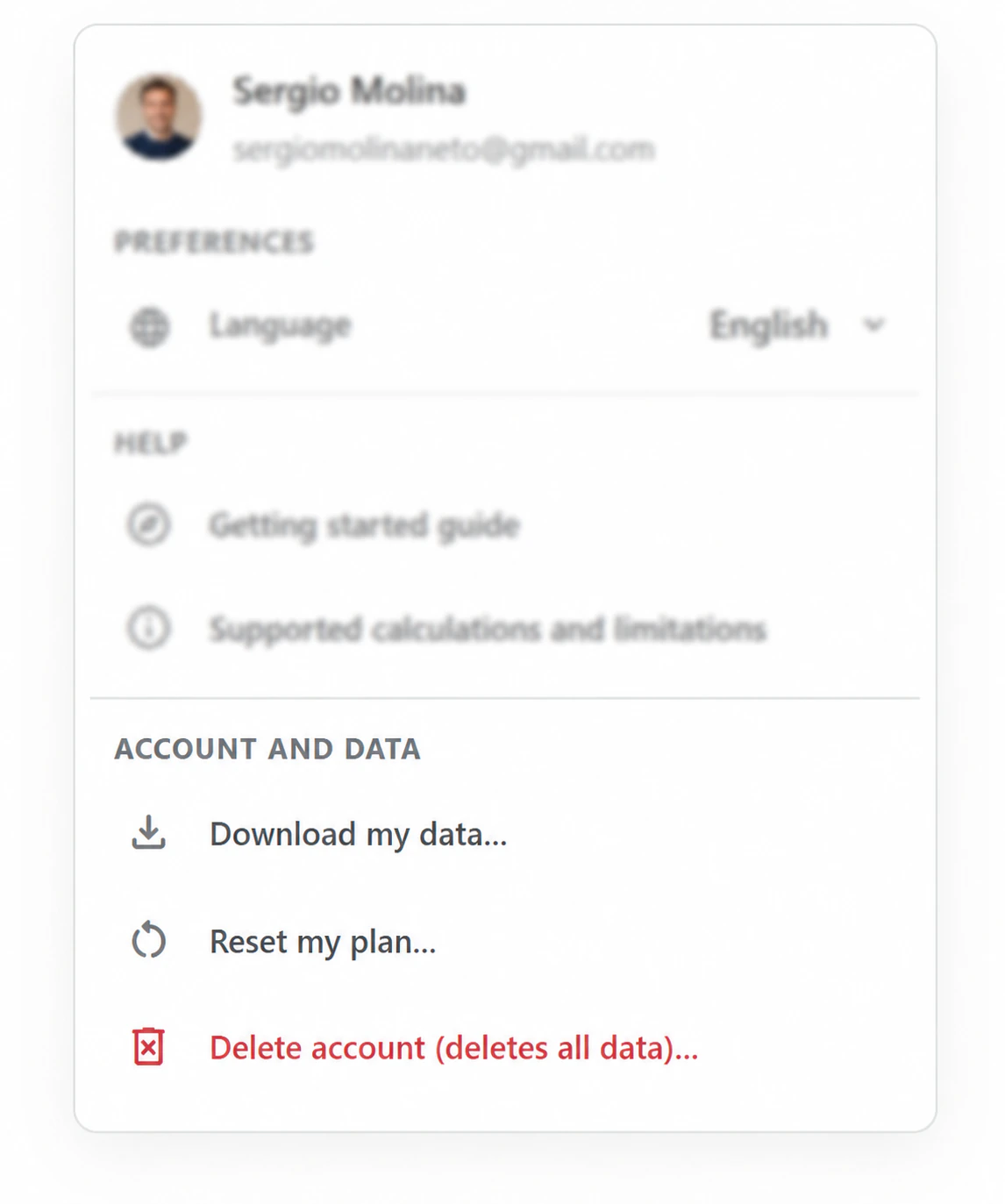
Review the financial information stored in your plan and download the information you have provided.
Reset your plan or permanently delete your account and its associated data from the app.
At the core of neto.es is a calculation engine built for Spain. It combines the Spanish rules that matter with your real data: income, IRPF, Social Security, public pension, housing, investments, debts, and liquidity in one monthly model. Each decision flows through the rest of the plan, because the result depends on how all the pieces evolve together over time.
For example: contributing more can reduce your financial room today, but improve your future public pension; buying a home can increase net worth, but leave less cash to invest; drawing from a private pension can cover a shortfall, but increase IRPF. neto.es connects those consequences in one projection, so you can see the full long-term effect.
For you, that means a reliable financial projection, with numbers you can trust as a basis for making decisions.